


— By Nan Sterman
Fried egg plant and matilija poppy are two names for Romneya coulteri, a giant of the poppy family. This big, beautiful perennial
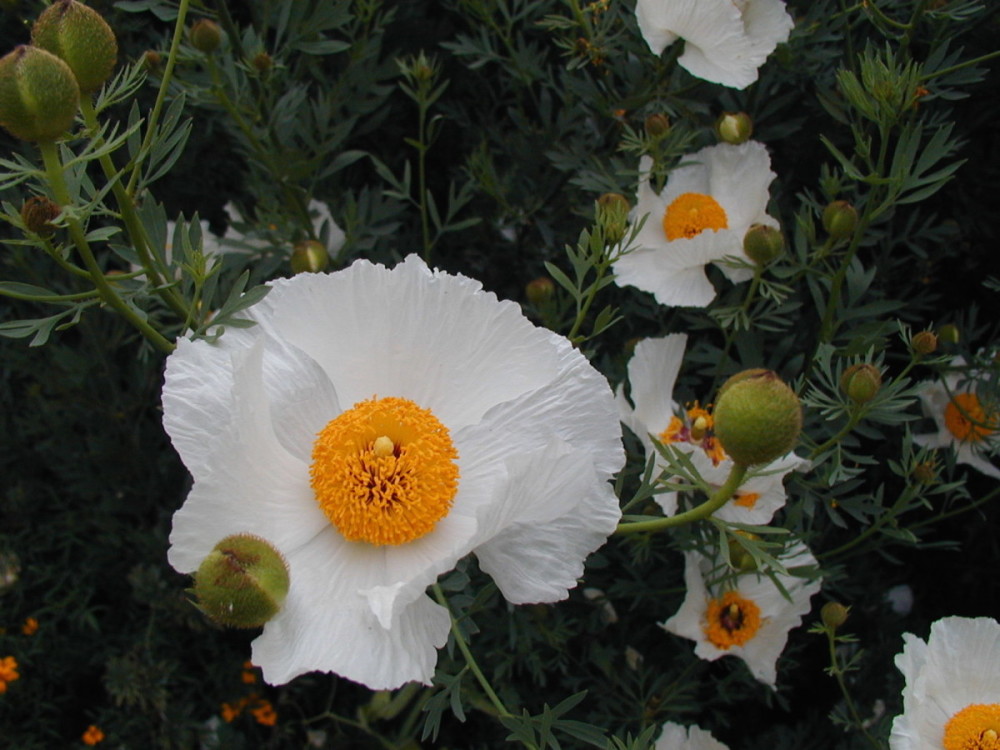
These big blooms inspired the name “fried egg plant” to describe these beautiful poppies. © Nan Sterman 2001
forms crepe papery flowers as large as salad plates. The combination of white petals and bright yellow center earn this plant the nickname “fried egg plant.” Matilija poppy is native to chaparral and coastal sage scrub habitats, primarily from Santa Barbara County
south into Baja, including San Diego County.
Matilija poppy plants form multiple upright stalks, 6 to 8-feet tall, thicker than a finger, and clothed in fringed blue-green leaves. Come late spring, the tip of each stalk develops marble to walnut-sized buds . Flowers start to open around the end of May and keep going into the summer – depending on your location and the weather.
These plants don’t fit a small garden. They do great on slopes and in places where there is room to spread – alot.

Start by planting Matilija poppy from a one gallon can. This size is easiest to plant without disturbing the plant’s roots – key to successfully growing these beautiful plants. ©Nan Sterman, 2001
Matilija poppies are very finicky about how they are planted. The trick is to plant without disturbing the roots.
- Plant in fall or winter into a spot with full sun and well draining soil. Plants also tolerate (and spread slower in) clay soils.
- Start with the smallest plant that has been grown in a pot – a one gallon is fine. Don’t bother digging plants up from another garden (and NEVER dig them from the wild).
- Water the plant so the roots are damp when they are planted.
- Dig a hole as deep as the root ball is tall, and twice as wide. Set the soil aside, you’ll need it to refill the hole.
- Fill the hole with water and let it drain.
- Lay the plant on its side. Use a sharp knife to cut out the entire bottom of the nursery can. Don’t let the plant slip out of the can. Instead, place your hand under the cut end of the pot to support the exposed rootball. Carefully lift and set the can (with the plant inside) into the hole.
- Remove your hand and adjust the plant’s position. Use your knife to slit up the sides of the can in two or three places.
- Fill the hole about a third of the way with native dirt (no amendments), and dampen the soil.
- Gently pull the pieces of the can away from the root ball. Carefully finish backfilling the hole with native soil.
- Water deeply a final time to settle the roots, then build a watering basin and complete the process the same as for any other plant.
- Place a root barrier at least six feet out from the plant to get a good show of spring flowers but still contain its spread.
- Mulch with rock or an organic based mulch
- Water periodically through dry periods in winter and the rest of the year so roots stay damp (not wet) through the establishment period which is one or two years. After that, chances are you can stop watering these beautiful plants altogether.
Poppy Wars: Matilija poppy was a candidate for state flower. It was beat out by the California poppy!
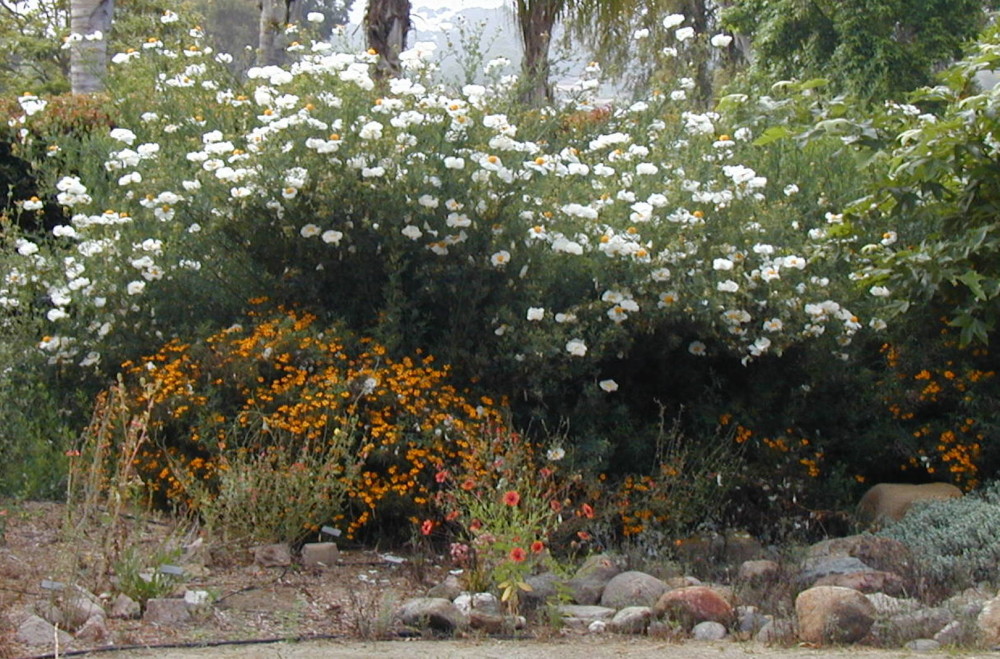
Matilija poppies are not for small gardens. Their massive spread is suited for slopes and large spaces. Three one-gallon matilija poppy plants quickly grew into this glorious mass in Nan Sterman’s garden. © Nan Sterman, 2001



I love matilija poppy but find it hard to grow. My mother-in-law, in Orange County, treats it like a weed and has great success. But here, in coastal San Diego, I’ve treated it like precious gold, and I’ve had little success. I’m not sure what I’m doing wrong. I plant it in a full-sun location with well-draining soil and moderate irrigation. Any advice?
What zone does this poppy grow?
I’m in New England Zone 6
And wondering if it will survive?
Tia
The poppy is native to zones 9/10 but I have seen it growing in England which suggests that it will survive in climates nearer to yours but I suspect it will not overwinter. The RHS lists it here https://www.rhs.org.uk/Plants/21715/Romneya-coulteri/Details – maybe you wil find a clue for growing it in your zone… good luck and let us know what happens!
Your experience is not unusual unfortunately. Here’s the issue – Matilija poppies are notoriously sensitive to having their roots disturbed, especially when you are planting them. With most plants, we want to shake off the dirt and unwrap the roots to encourage them to grow into the soil surrounding the panting hole. Not with Matilijas. Instead, dig the hole, fill it with water and let it drain. Water the plant too, in its container. Then, carefully cut out the bottom of the pot with a razor knife, making sure you don’t damage the roots. Put your hand under the cut end of the pot to hold the plant in place while you carefully lift the plant, pot and all, and gently set it into the hole. Then, using the razor knife to slit the side of the nursery pot, from bottom to top, in two places. Add some dirt in the hole to stabilize the plant, and gently lift away the container. Fill in the planting hole, and saturate it once it is full. Voila! You’ve just planted a matilija poppy without damaging its roots. Oh, and be sure you do this in fall, not spring.
My matilija poppies are prolific but only bloomed the first year, what can I do. They look great but no blooms. I live 8 miles from the ocean. I have never trimmed them, they seem to love growing here but I wonder if I should be pulling some of them out.
Thank you
It’s unusual for matilijas to grow but not bloom, Dorothy. Pulling some out would not solve the problem. Are they in full sun?
Hello Nan – thank you for writing about one of my favorite plants! Question for you – we planted 3 plants, 5 years ago. They seem established and have sent more plants our way. But, these last 2 years, they are not blooming prolifically and do not grow as tall. We cut them back each November to about 6 inches. We are inland Oceanside. They are surrounded by native plants, get moderate water and are in clay soil but have done well, just not these last two years. Any ideas? A neighboring park has months & month of bloom and I wonder if theirs are fertilized. Thought Matilija’s wouldn’t like that though. Any ideas? Thank you.
Hi Michelle
That does seem strange Michelle. Matilijas thrive on benign neglect. I have two thoughts about this. First, have you noticed whether something is eating the flower buds off the stalks? Keep an eye out for that. Second, stop watering. Matiljas grow naturally in hot, dry, sunny canyons. Mine grow in very sandy, porous soils. Both are situations where moisture is very minimal. So if you have clay and water them moderately, they might be staying too wet. Try that and let me know hot it goes.
Hi Nan, is it even possible to grow these from a seed and keep in a pot. It seems they would not like a pot. I live in an apartment. Maybe I can convince my apartment manager to grow them in the landscaping here 😃
Lori
Hi Nan –
I watch your show on KPBS and really enjoy it. I am wondering what other plants you would recommend to pair with the Matilija Poppies?
Katharine
Anything that will grow without water once it is established. It depends on the exposure, how much room you have and if you are asking about trees, shrubs, perennials, etc. Mine grow with a big mixture of trees and flowering shrubs that are never watered including the desert native Sophora secundiflora, a mesquite tree, Buddleia marrubifolia, native rose, Rosa minutifolia, and a bunch of succulents.
I’ve read the only way to TRY to propagate is by cutting root stock out, but it, too, difficult. I wondered why my poppy petals droop and look wilted; most plants doing fine, some not thriving–what to do/fertilize? with those. Do you cut off the dead flower pods? Maybe too much water, we’ve had a lot of rain.
I definitively adore my ‘Fried Egg Plant’! I grew one from seed via a specialty seed catalogue back in 1998. After nursing the seeds along for 4 months they (about 7 total) germinated just in time for February planting here in the Eastern Mojave Desert of Las Vegas, Nevada. After choosing a large barren area just on the other side of my backyard wrought iron fence in full desert sun with only hose water the first two years of growth, this lovely monster as grown to 8′ tall and 15′ wide! Blooms begin on April 1st and cease by June 20th or longer. It now gets by on just the natural rainfall we are blessed with here in the Mojave…which is normally 4 1/2 inches of moisture each year. Good luck to all.
You grew fried egg plant from seed! Wow that is a huge accomplishment and I’m impressed. Please visit our Facebook Page, https://www.facebook.com/AGrowingPassion/ and posting a photo? We’d love to see your “monster!”
I recently visited California and saw these beautiful Fried Egg poppies. I am wondering if these flowers could grow in Zone 5, North East Ohio.
Thanks for asking Claudia. Sadly,the chances of fried egg poppies surviving long term in your region are pretty slim. They want hot, dry soils, and temperatures not much below freezing. They don’t grow well in a pot at all either. You’ll just have to plan more trips to California so you can enjoy them!
I grow Romneya coulteri in the Denver metro area successfully. This year I had blooms on a plant that bloomed from early summer until now, and I still have one bud forming. The plant is nine years old and approximately four foot high. It is planted in a sandy loam on a north facing slope and receives sun from sunrise to at least mid afternoon. It is watered regularly. Its root probably extends down two feet or more, and is well entrenched. A couple of years ago, a utility crew had to replace and bury an underground power line; I feared I had lost it as the crew butchered it. No problem, it returned with even greater vigor than before. It suckers. And I just transplanted a bareroot offshoot to a new location: an east facing slope. The taproot was a foot long, and I could not dig to its base. I dug a hole the depth of the root, planted it into the hole, backfilled it, then soaked the hole for 5 days. It appears to have taken.
I recently saw a large colony of these plants in a friends garden on Vashon Island in the Puget Sound southwest of Seattle. I remember seeing them years ago as a young man in Mendicino, CA. I’d love to try and grow some on a very steep, dry, west facing slope in my home in Camas, WA. I’m concerned it might get too cold in the winter, but it is a fairly shelter location protected from the east winds out of the Columbia Gorge.
Do you think it would be worth trying?
Thanks…
Matilijia Poppy in 3ft wide terraced planter?
In order to avoid the spreading I would like to plant them in terraces formed by retaining walls that are only 3 feet wide.
Would the roots damage the concrete block retaining walls? Any advise would be appreciated..
Thank you!
Whether the terraces keep them in bounds probably depends on how deep the footings are. I would expect them to escape terraces so if you want to plant them I suggest doing it at the very top. Good luck!
Thank you for the quick feedback. I am considering using the Hairy Matilija Poppy, which is supposed to be less aggressive at least here in San Diego. I will follow your advise.
Thank you again
Hi Sori – I’m not sure where you found the information that the Hairy (or bristly) Matilija is less agressive – there is very little difference between the two species other than bristles ont the undersides of the flowers. Here’s a good reference: http://calscape.org/Romneya-trichocalyx-(Bristly-Matilija-Poppy)?srchcr=sc570bd6ca3a105.
From Bob Perry’s book Landscape Plants for Ca, he also mentions that it is not as common in occurrence, which probably means that I will not be able to find it in nurseries.
Many thanks for all this wanderful information.
Sori
Hello,
I live in New Zealand near the coast of the South island. I have this plant and it is planted between a chimney and the side of the house, It is in poor soil, never fed and only watered by the rain. Its roots must go down under the house where it obviously gets enough moisture, It is facing North West so gets afternoon sun. It is very hard to get in New Zealand and I don’t remember where I got mine from. It is about 30 years old now.
Thanks for sharing! How fun to know our California natives do so well so far from home!
Hello from The south of England I planted a tree poppie in my white garden and I was thrilled when I had three gorgeous fried egg blooms when I came down one morning I did not prune it as I didn’t realise I had to this year it looks poor it’s in a sunny south facing border any tips ?
Congratulations on growing one of our most beautiful California natives in your English garden! The RHS describes this poppy plant as being in pruning group 6, “Pruning late summer- or autumn-flowering shrubs annually in spring gives a better flowering display that year. Pruning also keeps growth in check and improves overall plant health.” That is about the same as our practices here in California. Read more about growing Matilija poppy in England here: https://www.rhs.org.uk/Plants/21715/Romneya-coulteri/Details
Mine is at least 10 feet tall and has lots of flowers and it is only 2 years old. My question is can I prune it back next winter. I did this last winter cut it back a little and so far so good.
Yes, definitely you can cut it back, once the stems start to brown in the fall. It will bounce back better than before.
Hi, I purchased a 1 gallon- nice root ball, and put it in a clay pot with cactus soil mix. Do you think it has a chance? I tried planting several inground but my clay soil holds too much water. Suggestions on watering?
Your matilija should live for a while in the clay pot but it won’t thrive. These beauties really need to be in the ground. If yours have not survived, the two most common failure points are root disturbance at planting (read the blog for planting directions) and overwatering. If you have clay soils, you are very lucky. Plant your Matilija in the fall once the temperature breaks, water it when you plant and never water it again. Really, don’t water it at all. That also means that you don’t want to plant it into a bed of other plants that need (or get) regular irrigation – Matilijas are not compatible with those plants. If you have a slope or hillside, that is ideal for Matilija poppies. If your garden is small, though, don’t even try. The poppy plants spread via underground runners and make a very large clump – again great on a slope or hillside, or in the back forty, but not in a small garden bed or in a manicured garden.
Hi,
How is the success rate of starting from seed that I collected?
Thanks,
SUE
Matilija poppy is reported to be pretty challenging to start from seed. My understanding is that the seeds need smoke to germinate, so many people burn pine needles in close proximity to the seeds to get them to start. This, by the way, is one of the reasons people describe chaparral as being “dependent” on fire. Chaparral doesn’t “need” fire in order to live, but some chaparral plants have seeds that germinate only after they’ve been exposed to fire. If you try it, let us know how well it works.
I had great success with my RC here in Half Moon Bay until the caterpillars got it end of August. I noticed that there were no more buds, some dark ends where there should have been buds, and leaf damage. Then I found the culprits: tiny green 1 cm caterpillar hanging by a stringy thread similar to a spider. I cut the plant down to the green to rid itself from the pests.
– Should I have done so?
– could I have used a garden friendly pesticide? Which formula?
– why did they attack only the RC?
I have sweet peas, petunias, euphoria and lion’s tail nearby.
I haven’t heard of worms getting these poppies before, but wheneve you have a caterpillar in the garden and decide he needs to go (not all are desctructive), get some Bt. Bt is Bacillus thurigenensis, a tiny bacteria that kills worms (caterpillars are technically a kind of worm) and mosquito larvae. It is one of – if not the – first biological pesticides. Find it in the nursery and use it liberally. It won’t hurt anything else.
Pingback: In the Garden – December 2018 – spades, spatulas & spoons
Hi I bought one from our local gardening club sale.
They are now spreading and would like to know if I take them out will they survive a transplant?
I live in the northwest corner of Washington state (Mount Vernon) where my three first-year RC plants endured 3 weeks of never ending snow in February and 15 degree nights for nearly 2 of those weeks. I had put one plant in a buried feed bucket with holes drilled all over the bottom, in an attempt to keep the roots contained. It was about 3 ft. by 2 ft. That plant did not survive. I think with all our rain and snow, the holes in the bottom just didn’t drain the water fast enough. The other 2 were planted in a large garden island (about 20 feet X 30 feet) and were slow to come up this spring, but seem to be doing fine now. the plot rises upward and the soil stays moist all winter due to the multiple days of non-stop rain and cold temps, but the water is not trapped. I’ve allowed space for each plant to fill in about 6 feet diameter. If it spreads more, will pruning the spreading roots harm the mother plant? They grow beautifully in the very, very fertile soil in the valley below (some of the best agriculture land in the state) at the nursery where I bought my plants, and appear well contained to 2 sturdy robust plants (right now the base of each is about an 18-inch diameter, but they develop many, many stems and form a much broader top). The nursery has professional gardeners tending all the gardens and using nutritious mulch, so I’m confused when I read they thrive in the Mojave desert on neglect and struggle when tended to. I have four acres and have planted 3 plants randomly on the sunny side of a band of trees, but in the winter the sun swings very low and our nights are very long so they’ll never get sun during those months. With our heavy rainfall I’ve planted them all on banks or mounded garden islands to hopefully let the water drain down all winter. I LOVE these plants and really want to grow them successfully. What do you make of all this?