
facebook
rss
twitter
youtube
pinterest
  • Home
  • About
    • The Host, Nan Sterman
    • Awards and Reviews
    • Behind the Scenes
  • Videos
    • Clips/Segments
  • TV Schedule
    • Episode 701: The Beautiful Bromeliad
    • Episode 702: Beans, Beans – The Magical Legume
    • Episode 703: Grow Tiny
    • Episode 704: Food Is A Terrible Thing To Waste!
    • Episode 705: The Big Bloom
    • Episode 706: Gardening as a Community
    • Season 6
      • Episode 601: From Fruit to Nuts
      • Episode 602: Intoxicating Plumeria
      • Episode 603: The Art of a Garden
      • Episode 604: From Farm to Fork
      • Episode 605: Growing A Greener Golf Course
      • Episode 606: Plants: The Endangered Species
    • Season 5
      • Episode 501: Homegrown Hops – Local Flavor for Local Brews
      • Episode 502: Distant Roots And Tasty Shoots – Plants At The Zoo
      • Episode 503: The Story Of Seeds – From Breeding To Eating
      • Episode 504: Aquaponics – Fish Poop To Plant Roots
      • Episode 505: Urban Forests – Trees And Plants In The City
      • Episode 506: Wild And Wooly – Native Bee Pollinators
    • Season 4
      • Episode 401: Flowers and Floats – The Rose Parade
      • Episode 402: Citrus – California’s Second Gold Rush
      • Episode 403: Beneficial Insects
      • Episode 404: Bye, Bye Grass – How To Remove Your Lawn
      • Episode 405: After the Lawn is Gone – Waterwise Gardens
      • Episode 406: All About Algae
    • Season 3
      • Episode 301: Balboa Park: The Garden Faire
      • Episode 302: Big Trees: Giants Among Us
      • Episode 303: Garden Tours & Garden Shows: Finding Garden Inspiration
      • Episode 304: Preserve the Harvest
      • Episode 305: Coming to a Nursery Near You
      • Episode 306: How Water Flows
    • Season 2
      • Episode 201: From Vines and Wines
      • Episode 202: Chaparral, The Elfin Forest
      • Episode 203: Green Roofs
      • Episode 204: New Models of Farming
      • Episode 205: With Food and Justice for All
      • Episode 206: Growing Dreams and Memories
    • Season 1
      • Episode 101: The Business of Blooms
      • Episode 102: California Native Grown
      • Episode 103: Grow Your Own
      • Episode 104: Waterwise and Wonderful
      • Episode 105: Cycle and Recycle
      • Episode 106: Garden in a Pot
  • Explore More
  • Support The Show
  • Blog
  • Sponsors & Supporters
    • Founders
  • Shop
  • Contact

Let’s Visit the Orchid House

June 22, 2017
by Nan
Balboa Park, bees, CITES, Endangered plants, epiphyte, fragrance, Greenhouse, Mexico, Orchids, pollinator, san diego zoo, San Diego Zoological Society, US Fish and Wildlife Service, USFWS, vainlla bean, vanilla, vine
0 Comment

— By Nan Sterman

This week’s episode of A Growing Passion is “Distant Roots and Tasty Shoots,” a visit to the San Diego Zoo’s amazing plant collections. We tour the Zoo’s orchid house in one of the segments.

I am always amazed at the variety and beauty of orchids.

The orchid house is actually two small greenhouses and an outside area chock full of fantastic, beautiful orchids. The unusual thing about this collection is how it came to be. These orchids came to the US illegally and were confiscated by the US Fish and Wildlife Service.

Protected Plants

Orchids, like many other plants, fall under the protection of the Convention on International Trade in Endangered Species of Wild Fauna and Flora – “CITES” for short. Plants that are protected under CITES also include species of cycads, palms, cacti, medicinal plants and others. When those protected plants are confiscated at our borders, they don’t just get boxed up and returned in the mail. Instead, they are sent to a designated Plant Rescue Centers (PRCs). There are 80 designated PRCs at botanical gardens, research centers, and other institutions in 24 states, the District of Columbia, and Puerto Rico. Different kinds of plants go to different PRCs; luckily for us, the Zoo’s PRC houses orchids.

Orchids: Brains and Beauty

When I visit the orchids, I can’t ever seem to tear myself away. The variety of plant shapes and sizes is almost as amazing as the variety of flower shapes and sizes. Some are as big as softballs, others as tiny as pinheads.
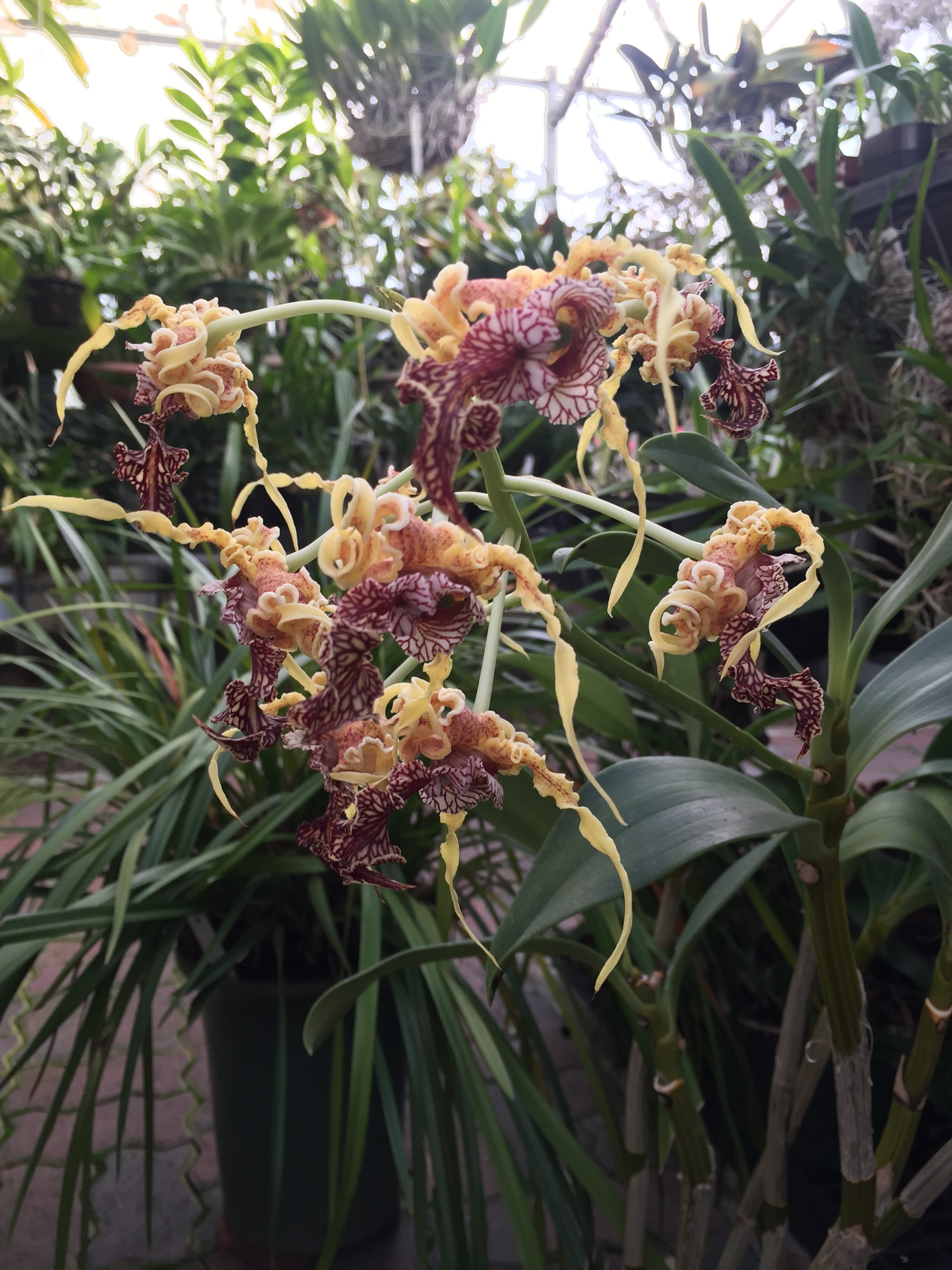
Orchid Dendrobium spectabile

Most orchids are epiphytes (they grow anchored on the branches of trees and other plants), while others are terrestrials so they grow directly in the ground. Some have rounded flowers, others are triangular, and still other flowers are almost tube shaped. Some flowers point downward (pendant),others are oriented so I look at the flowers face-to-face.

Orchid colors nearly span the rainbow; oranges, pinks, yellows, whites, purples, greens, burgundy, reds… I’ve never seen true blue orchids, though some on the market are dyed blue; they look very unnatural.

While the diversity of orchid flower shapes and markings look fantastical and random to us, these highly evolved flowers are anything but random. If you were a potential pollinator, those markings would be like an orchid billboard, beckoning you to, in biological terms, “pseudocopulate.” Here are some articles (1, 2) about the fascinating sex life of orchids and their pollinators.

Fragrance is another way that flowers, particularly white and other pale color flowers, attract pollinators. In the humid air of the orchid greenhouse, those fragrances are amplified – enhancing the intoxicating human experience.

Visit the Orchid House
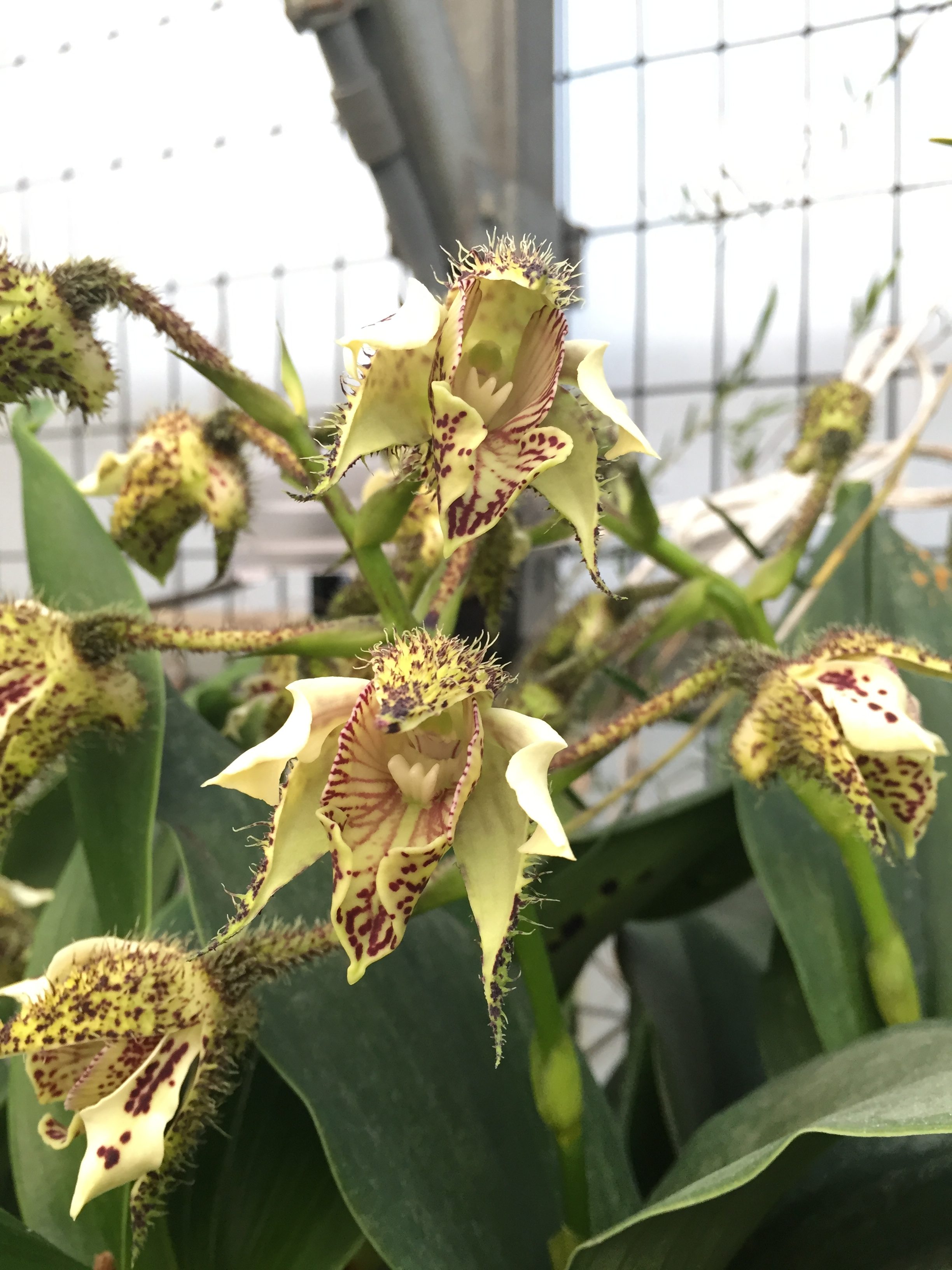
Wonder what this orchid’s pollinator looks like

The San Diego Zoo’s orchid house sits behind big gates hidden from the Zoo’s public areas. On the third Friday of every month, they open thegates and invite in the public from 10 am to 2 pm. If you are an orchid lover (and who isn’t an orchid lover???), don’t miss your chance to tour the collection.

DID YOU KNOW…

Vanilla flavoring is derived from vanilla orchids, 50 to 75 ft. tall terrestrial or epiphytic vines native to Mexico. While there are several species, Vanilla planifolia is used in commercial vanilla production. A tiny bee pollinates the yellow-green vanilla orchid flowers, which eventually form a bean that is cured to bring out their vanilla essence. The term “bean” is a misnomer since Vanilla orchids are not related to beans, even though their seedpods have similar shapes.

The vanilla orchid vine climbs a tall palm tree in Florida


About the Author
California native Nan Sterman is host, co-producer, and co-writer of A Growing Passion, a television show that explores the ways plants power the planet, from farms and nurseries to backyards and schoolyards, rooftop gardens, community gardens, native habitats and more.
Social Share
  • google-share

Leave a Reply Cancel reply

*
*


Popular Posts

A big fried egg sized bloom
Grow a Fried Egg Plant - Matilija poppy
38 Comments
Tree babies
How to Water Your Trees
8 Comments
Stolons make Bermuda grass a challenge to remove
Whether Weed Cloth?
7 Comments

Categories

  • Agriculture
  • Animals
  • Art
  • Behind the Scenes
  • Botanical Garden
  • Community
  • Community Supported Agriculture
  • Cooking
  • Design
  • Explore More
  • Farm
  • Farm-to-Table
  • Food Justice
  • Fruit
  • Garden
  • Gardening
  • Gifts
  • History
  • How-to
  • Insects
  • Nan Sterman
  • Native Habitat
  • Nursery
  • Organic Farming
  • Plants
  • Projects
  • Public Gardens
  • Research
  • Tour
  • Travel
  • Vegetable Gardening
  • Waterwise
  • What's New
  • What's Trending

Archives

Contact Us

AGP Productions, LLC
PO Box 231034
Encinitas, CA 92023
info@agrowingpassion.com

Follow Us!

Follow Us on FacebookFollow Us on TwitterFollow Us on InstagramFollow Us on PinterestFollow Us on YouTubeFollow Us on RSS

Press

  • Media
  • Press
Ask-Nan
All Content and Images © 2018 AGP Productions, LLC | Privacy Policy
Designed by Belladia Marketing and Design