
facebook
rss
twitter
youtube
pinterest
  • Home
  • About
    • The Host, Nan Sterman
    • Awards and Reviews
    • Behind the Scenes
  • Videos
    • Clips/Segments
  • TV Schedule
    • Episode 701: The Beautiful Bromeliad
    • Episode 702: Beans, Beans – The Magical Legume
    • Episode 703: Grow Tiny
    • Episode 704: Food Is A Terrible Thing To Waste!
    • Episode 705: The Big Bloom
    • Episode 706: Gardening as a Community
    • Season 6
      • Episode 601: From Fruit to Nuts
      • Episode 602: Intoxicating Plumeria
      • Episode 603: The Art of a Garden
      • Episode 604: From Farm to Fork
      • Episode 605: Growing A Greener Golf Course
      • Episode 606: Plants: The Endangered Species
    • Season 5
      • Episode 501: Homegrown Hops – Local Flavor for Local Brews
      • Episode 502: Distant Roots And Tasty Shoots – Plants At The Zoo
      • Episode 503: The Story Of Seeds – From Breeding To Eating
      • Episode 504: Aquaponics – Fish Poop To Plant Roots
      • Episode 505: Urban Forests – Trees And Plants In The City
      • Episode 506: Wild And Wooly – Native Bee Pollinators
    • Season 4
      • Episode 401: Flowers and Floats – The Rose Parade
      • Episode 402: Citrus – California’s Second Gold Rush
      • Episode 403: Beneficial Insects
      • Episode 404: Bye, Bye Grass – How To Remove Your Lawn
      • Episode 405: After the Lawn is Gone – Waterwise Gardens
      • Episode 406: All About Algae
    • Season 3
      • Episode 301: Balboa Park: The Garden Faire
      • Episode 302: Big Trees: Giants Among Us
      • Episode 303: Garden Tours & Garden Shows: Finding Garden Inspiration
      • Episode 304: Preserve the Harvest
      • Episode 305: Coming to a Nursery Near You
      • Episode 306: How Water Flows
    • Season 2
      • Episode 201: From Vines and Wines
      • Episode 202: Chaparral, The Elfin Forest
      • Episode 203: Green Roofs
      • Episode 204: New Models of Farming
      • Episode 205: With Food and Justice for All
      • Episode 206: Growing Dreams and Memories
    • Season 1
      • Episode 101: The Business of Blooms
      • Episode 102: California Native Grown
      • Episode 103: Grow Your Own
      • Episode 104: Waterwise and Wonderful
      • Episode 105: Cycle and Recycle
      • Episode 106: Garden in a Pot
  • Explore More
  • Support The Show
  • Blog
  • Sponsors & Supporters
    • Founders
  • Shop
  • Contact

Poinsettias for the holiday season

November 17, 2014
by Nan
Armstrong Growers, Christmas, Cut flowers, flower, Flowers, Garden, Gardening, Greenhouse, holiday, Plants, poinsettia
0 Comment

— By Nan Sterman

Poinsettia season is upon us!  Growers ship out the bright red and soft yellow colored plants every day, sending them to nurseries and garden centers across the country.
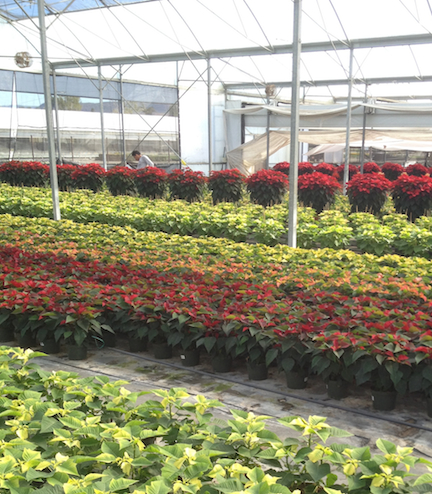
A rainbow of poinsettias await being shipped to gardens, nurseries, and resorts across California

A rainbow of poinsettias await being shipped to gardens, nurseries, and resorts across California

Thanks to late Encinitan Paul Ecke Jr., poinsettias are the plants we mostly closely associate with the holiday season. You might be surprised to learn, however, that poinsettias originated in the semi-arid regions of Mexico. They are tough plants that can go from house to garden with surprising ease.
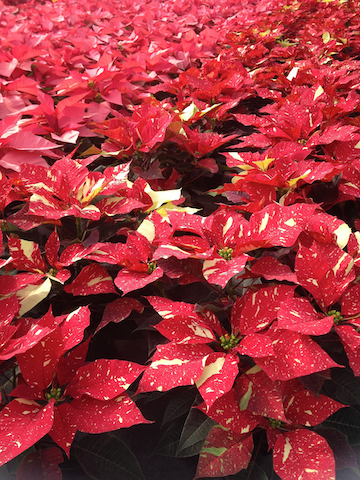
Poinsettias offer an amazing variation in flower size, shape, and color, including this speckled poinsettia grown by Armstrong Growers.

Poinsettias offer an amazing variation in flower size, shape, and color, including this speckled poinsettia grown by Armstrong Growers.

The botanical name for poinsettias is Euphorbia pulcherrima. The Euphorbia family includes many common garden plants and many succulents such as crown of thorns (Euphorbia milii). Collectively, the plants in this genus are called “spurges.”

In their native Mexico, in-ground poinsettias grow to large shrubs, even small trees, ten or twelve feet tall and wide. What we think of as poinsettia flowers are really brightly colored bracts. The actual flowers are tiny yellow structures in the very center of the bracts. It’s those bracts, that make the plants so attractive. They are also what breeders tinker with to create different colors and patterns.

Growing poinsettias indoors can be a little tricky. Ironically, they most often die from overwatering. Water infrequently and let the soil surface dry out between waterings. Drainage is important so remove the fancy foil wrapper as soon as you get the plant in your house.   If you place a plate or bowl beneath the pot to catch excess water, prop up the pot on gravel or pot feet so the poinsettia sits above the water.

To keep your poinsettia going indoors, place it in bright light where temperatures stay in the mid 60’s.

Once the holidays are over, don’t throw your poinsettia away – plant it in the garden. Along California’s south coast, plant just after the new year. Inland, plant until early April, or until there is no danger of frost. Plant into well draining soils. Just like container grown poinsettias, in-ground poinsettias die if kept too wet.

Daytime light isn’t nearly as important as night light management for these fall/winter bloomers. Poinsettias bloom only if they have total nighttime darkness from September to December. Total nighttime darkness means no light from a nearby window or streetlight or house light. None. Interestingly, this characteristic was one key to Ecke’s success. In a greenhouse, he could easily emulate long, dark nights.
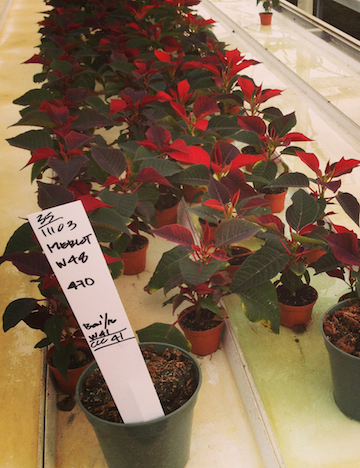
Breeders constantly work on developing new varieties of poinsettias, new colors, new sizes, new flower shapes.

Breeders constantly work on developing new varieties of poinsettias, new colors, new sizes, new flower shapes.

Poinsettias go into a state of suspended animation when nighttime temperatures fall below 60 degrees, so after you plant, don’t expect to see any growth until spring. In fact, it’s common for poinsettias to go into transplant shock and temporarily drop all their leaves shortly after planting.

Once that new spring growth begins, and daytime temperatures exceed 60 degrees F, fertilize monthly with a general-purpose organic fertilizer. Follow the directions on the package.

If you like big, rangy poinsettias, don’t bother pruning. But if you prefer more compact, bushier plants, prune according to the holidays. Prune the branches back by up to half on Memorial Day. Prune again on the 4th of July and again on Labor Day. Shape the plant as you prune. New flower buds start to form after Labor Day, so stop pruning or you will cut off the buds.

About the Author
California native Nan Sterman is host, co-producer, and co-writer of A Growing Passion, a television show that explores the ways plants power the planet, from farms and nurseries to backyards and schoolyards, rooftop gardens, community gardens, native habitats and more.
Social Share
  • google-share

Leave a Reply Cancel reply

*
*


Popular Posts

A big fried egg sized bloom
Grow a Fried Egg Plant - Matilija poppy
38 Comments
Tree babies
How to Water Your Trees
8 Comments
Stolons make Bermuda grass a challenge to remove
Whether Weed Cloth?
7 Comments

Categories

  • Agriculture
  • Animals
  • Art
  • Behind the Scenes
  • Botanical Garden
  • Community
  • Community Supported Agriculture
  • Cooking
  • Design
  • Explore More
  • Farm
  • Farm-to-Table
  • Food Justice
  • Fruit
  • Garden
  • Gardening
  • Gifts
  • History
  • How-to
  • Insects
  • Nan Sterman
  • Native Habitat
  • Nursery
  • Organic Farming
  • Plants
  • Projects
  • Public Gardens
  • Research
  • Tour
  • Travel
  • Vegetable Gardening
  • Waterwise
  • What's New
  • What's Trending

Archives

Contact Us

AGP Productions, LLC
PO Box 231034
Encinitas, CA 92023
info@agrowingpassion.com

Follow Us!

Follow Us on FacebookFollow Us on TwitterFollow Us on InstagramFollow Us on PinterestFollow Us on YouTubeFollow Us on RSS

Press

  • Media
  • Press
Ask-Nan
All Content and Images © 2018 AGP Productions, LLC | Privacy Policy
Designed by Belladia Marketing and Design