
facebook
rss
twitter
youtube
pinterest
  • Home
  • About
    • The Host, Nan Sterman
    • Awards and Reviews
    • Behind the Scenes
  • Videos
    • Clips/Segments
  • TV Schedule
    • Episode 701: The Beautiful Bromeliad
    • Episode 702: Beans, Beans – The Magical Legume
    • Episode 703: Grow Tiny
    • Episode 704: Food Is A Terrible Thing To Waste!
    • Episode 705: The Big Bloom
    • Episode 706: Gardening as a Community
    • Season 6
      • Episode 601: From Fruit to Nuts
      • Episode 602: Intoxicating Plumeria
      • Episode 603: The Art of a Garden
      • Episode 604: From Farm to Fork
      • Episode 605: Growing A Greener Golf Course
      • Episode 606: Plants: The Endangered Species
    • Season 5
      • Episode 501: Homegrown Hops – Local Flavor for Local Brews
      • Episode 502: Distant Roots And Tasty Shoots – Plants At The Zoo
      • Episode 503: The Story Of Seeds – From Breeding To Eating
      • Episode 504: Aquaponics – Fish Poop To Plant Roots
      • Episode 505: Urban Forests – Trees And Plants In The City
      • Episode 506: Wild And Wooly – Native Bee Pollinators
    • Season 4
      • Episode 401: Flowers and Floats – The Rose Parade
      • Episode 402: Citrus – California’s Second Gold Rush
      • Episode 403: Beneficial Insects
      • Episode 404: Bye, Bye Grass – How To Remove Your Lawn
      • Episode 405: After the Lawn is Gone – Waterwise Gardens
      • Episode 406: All About Algae
    • Season 3
      • Episode 301: Balboa Park: The Garden Faire
      • Episode 302: Big Trees: Giants Among Us
      • Episode 303: Garden Tours & Garden Shows: Finding Garden Inspiration
      • Episode 304: Preserve the Harvest
      • Episode 305: Coming to a Nursery Near You
      • Episode 306: How Water Flows
    • Season 2
      • Episode 201: From Vines and Wines
      • Episode 202: Chaparral, The Elfin Forest
      • Episode 203: Green Roofs
      • Episode 204: New Models of Farming
      • Episode 205: With Food and Justice for All
      • Episode 206: Growing Dreams and Memories
    • Season 1
      • Episode 101: The Business of Blooms
      • Episode 102: California Native Grown
      • Episode 103: Grow Your Own
      • Episode 104: Waterwise and Wonderful
      • Episode 105: Cycle and Recycle
      • Episode 106: Garden in a Pot
  • Explore More
  • Support The Show
  • Blog
  • Sponsors & Supporters
    • Founders
  • Shop
  • Contact

How I Solved My Farm-to-Fork Challenge

May 17, 2018
by Nan
critters, farm-to-fork, farm-to-table, galvanized wire, Garden, Greenhouse, hoop house, Nan Sterman, raised beds, varmints, vegetable garden, vegetables, wire mesh
0 Comment

— Nan Sterman

When I dine out, my first choice is always farm-to-fork and farm-to-table. When I cook at home, my first choice is my own farm-to-fork. My little “farm” is the vegetable garden where I’ve grown all kinds of edibles, from artichoke to zucchini, for more than 20 years.

In the last few years, however, I haven’t grown any vegetables, though not for lack of desire or lack of effort. Ever year, I start my vegetable seeds and plant the seedlings as
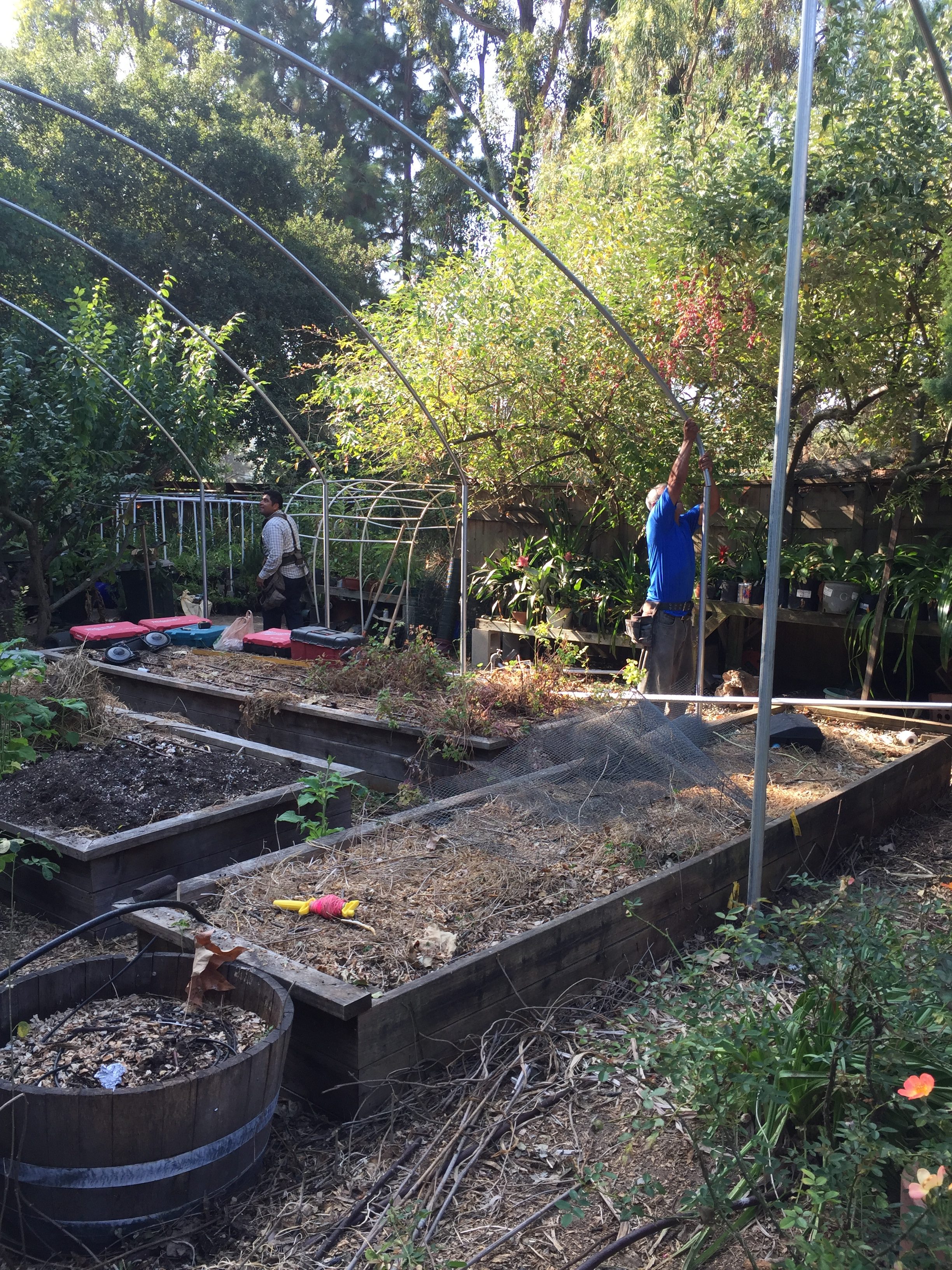
Arches are connected to metal poles on day two.

the weather warms. But as fast as I plant, the seedlings disappear!

Since my neighborhood is fairly rural, lots of critters visit my garden. In the past, they’d take a bite out of a juicy, ripe tomato or a luscious melon. But we seemed to have reached a point where my produce no longer satisfied those varmints. Instead, they ate whole plants, right down to their roots!

I tried trapping, but there were too many critters for that. I wouldn’t use poison. The best solution, was exclusion.

I decided to build a HUGE cage.  I envisioned a wood framed, galvanized, wire-mesh (aka “hardware cloth”) room over my  20’ x 20’ vegetable garden. I talked to my older son who (fortunately) is a contractor. He told me that such a large overhead span of mesh would require a support post in the center of the garden. I looked at the garden layout – the post would stand right in the middle of a raised bed.

I passed on that option.

Next, he offered to cage each raised bed individually. He’d build mesh covered frames with hinged doors I could open when I needed to weed or pick or plant. But I grow

eight-foot tall sunflowers and five-foot tall tomato plants. Cages that big would be unweildy, and smaller cages wouldn’t accomodate my plants.
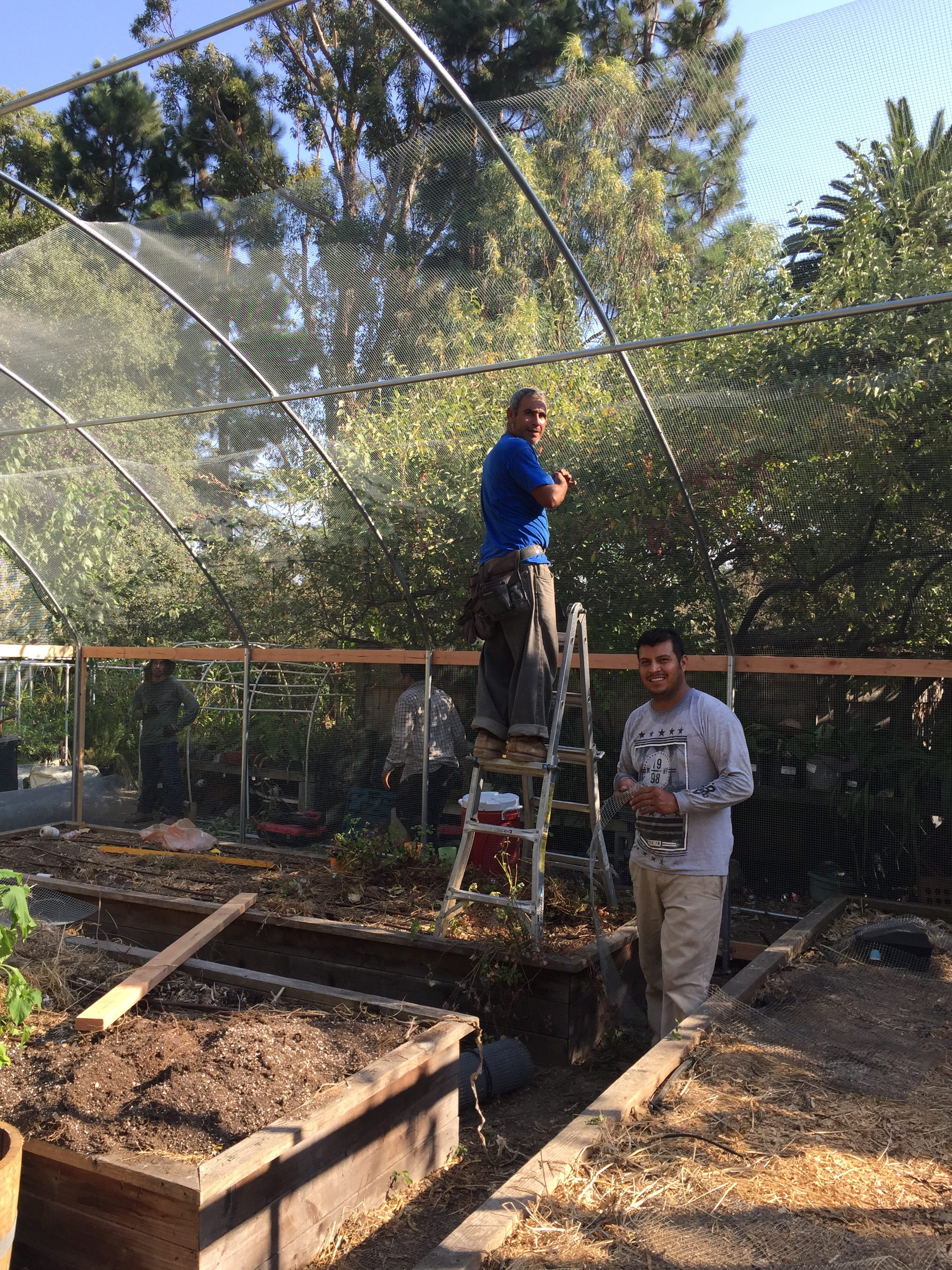
The wire mesh gets stretched over aliminum poles in my new “greenhouse”

And besides, caging animals out also meant caging me out. It would be really inconvenient. I knew I would get frustrated and the plants wouldn’t get enough care or attention.

Then, one day last summer, I was talking with the general manager of a nearby wholesale nursery. As we chatted, I looked over his shoulder and noticed plastic-covered hoop houses filled with potted plants.  Of course I’d seen them before but at that moment, a proverbial lighbulb went off.

Me: “How wide are those hoop houses?”

Him: “Oh, about 20 feet”

Me:  “Where do you get the metal ribs to build them?”

Him: “There’s a guy in town who fabricates them for me”

Me: “What’s his name?”

So, on the hottest day of summer, Gilberto and his crew were in my backyard, installing a screen-covered “greenhouse.”  They’d built countless hoop houses before, but never

one covered in wire mesh.  I special-ordered extra-wide rolls of mesh (the standard is just four feet wide) to accommodate the scale of the structure.
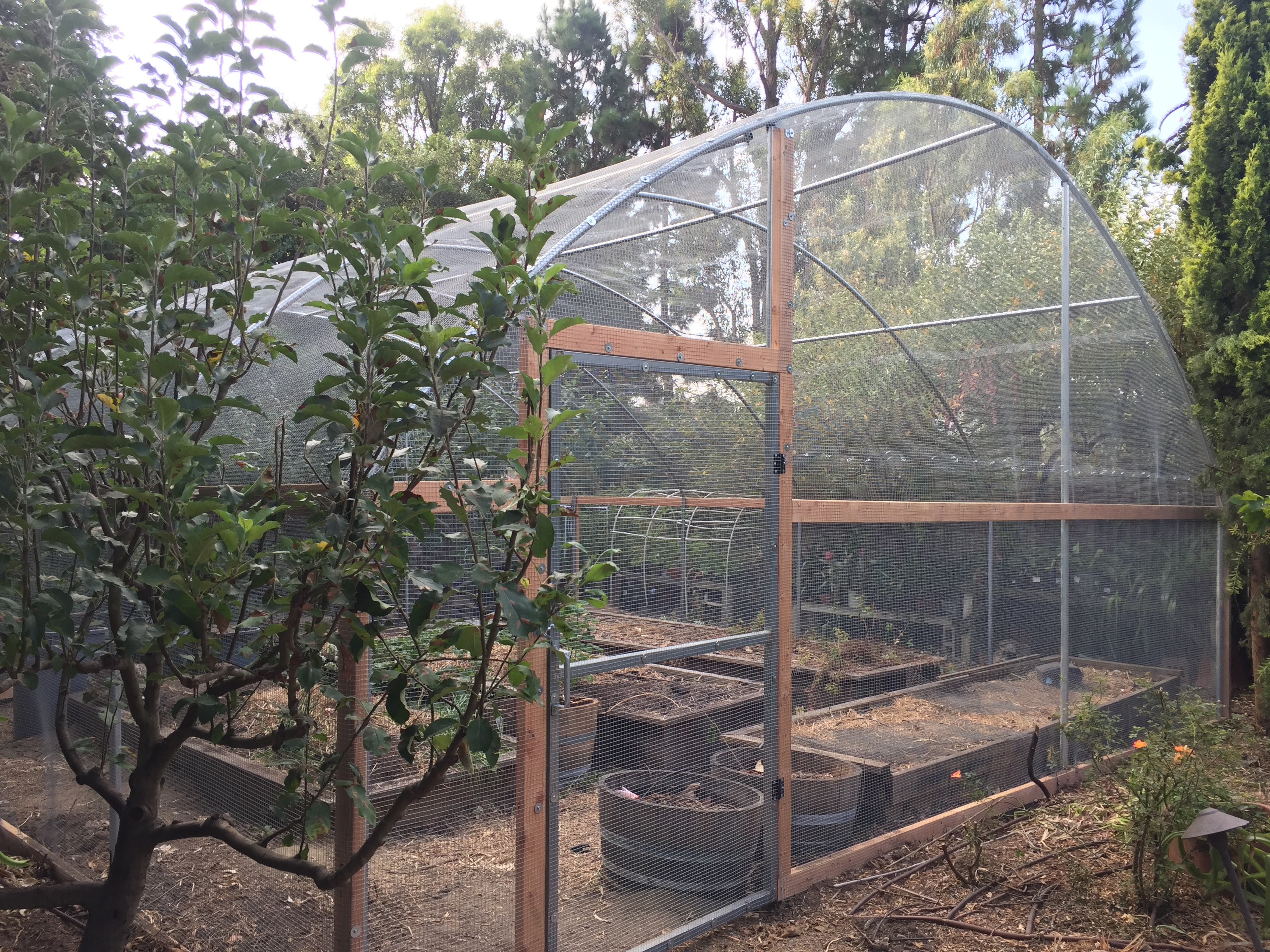
The greenhouse is finished and ready for vegetable seedlings!

The first day, the crew set the metal support poles in concrete. On day two they added arches they’d fabricated in their workshop. Then, they started stretching the wire. On day three, they finished with the wire and added a metal door that Gilberto proudly showed me he’d custom welded for my project.

This year, I started summer vegetable seeds in my annual February seed-starting workshops. Because of a late cold snap, the seedlings stayed small until just a few weeks ago. Finally, they were ready.  I took a deep breath, then planted.

Tomatoes, cucumbers, eggplant, basil, peppers….Every seedling went into a raised bed and so far… nothing has been eaten. Yeah!

So far, the seedlings are doing fine.  Each week, they seem to double in size. And I am so excited to be growing vegetables again!

And as excited as I am about growing vegetables, I’m just as excited about cooking and eating them. I’ve finally solved my farm-to-fork challenge!

About the Author
California native Nan Sterman is host, co-producer, and co-writer of A Growing Passion, a television show that explores the ways plants power the planet, from farms and nurseries to backyards and schoolyards, rooftop gardens, community gardens, native habitats and more.
Social Share
  • google-share

Leave a Reply Cancel reply

*
*


Popular Posts

A big fried egg sized bloom
Grow a Fried Egg Plant - Matilija poppy
38 Comments
Tree babies
How to Water Your Trees
8 Comments
Stolons make Bermuda grass a challenge to remove
Whether Weed Cloth?
7 Comments

Categories

  • Agriculture
  • Animals
  • Art
  • Behind the Scenes
  • Botanical Garden
  • Community
  • Community Supported Agriculture
  • Cooking
  • Design
  • Explore More
  • Farm
  • Farm-to-Table
  • Food Justice
  • Fruit
  • Garden
  • Gardening
  • Gifts
  • History
  • How-to
  • Insects
  • Nan Sterman
  • Native Habitat
  • Nursery
  • Organic Farming
  • Plants
  • Projects
  • Public Gardens
  • Research
  • Tour
  • Travel
  • Vegetable Gardening
  • Waterwise
  • What's New
  • What's Trending

Archives

Contact Us

AGP Productions, LLC
PO Box 231034
Encinitas, CA 92023
info@agrowingpassion.com

Follow Us!

Follow Us on FacebookFollow Us on TwitterFollow Us on InstagramFollow Us on PinterestFollow Us on YouTubeFollow Us on RSS

Press

  • Media
  • Press
Ask-Nan
All Content and Images © 2018 AGP Productions, LLC | Privacy Policy
Designed by Belladia Marketing and Design